

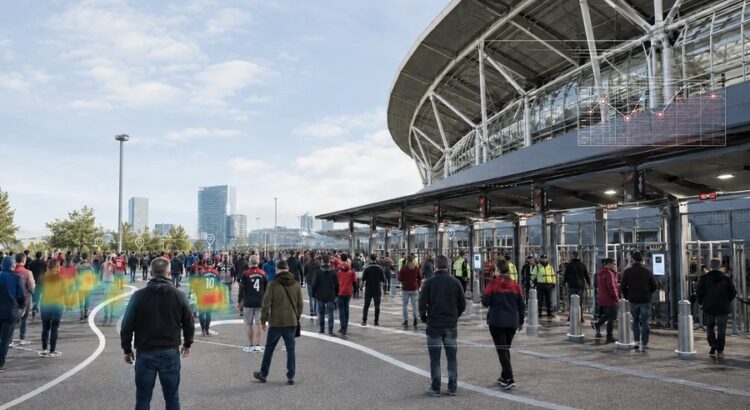
India’s cities are growing at a pace that puts pressure on every layer of public infrastructure. From metro transit systems to heritage sites hosting millions of visitors, the challenge of managing large gatherings safely and efficiently has become one of the most urgent operational priorities for city planners, event organisers, and public safety teams. Traditional approaches, built on static plans, manual observation, and reactive responses, are no longer sufficient for the scale and complexity involved. Real-time crowd monitoring is changing how that challenge is met.
What Real-Time Crowd Monitoring Means in Practice
Real-time crowd monitoring leverages IoT sensors, cameras and sometimes artificial intelligence technology to track crowd flow, movement patterns, and spatial density across high-volume environments. The data is then integrated with information including physical infrastructure, crowd activity, transportation systems, public facilities, emergency services, and operational resources into a single, continuously updated platform. Rather than piecing together separate feeds from different systems after the fact, operators gain a unified view of how people are moving, where pressure is building, and how conditions are evolving across a venue or city corridor as events unfold.
The core value is lead time. Real-time crowd monitoring gives planners and command centres the ability to spot emerging pressure points early enough to act before congestion becomes risk and before bottlenecks become incidents. With the right choices of sensors and monitoring platform, decision makers can even scenario plan and optimise operational management before major events.
Event Crowd Management at Every Stage
Before an event begins, a crowd monitoring platform’s value lies in preparation. Historical operational data combined with real-time feeds can be used to model expected crowd behaviour across venues, transport hubs, and city corridors ahead of time. This allows teams to identify emerging risks before they develop, plan the deployment of personnel and resources based on evidence rather than estimates, and evaluate route capacities in advance. Parking management, emergency corridor planning, traffic monitoring, and route optimisation can all be informed by the data insights.
During the event, the platform gives command centres a live, single view of how crowds and vehicles are moving together across the operational area. Instead of coordinating across separate communication channels and fragmented data feeds, operators can see conditions as they change and surface pressure points early enough to reroute people or adjust resourcing before situations escalate. That shift from reactive to responsive management is what real-time crowd monitoring fundamentally enables.
After the event, the data does not become redundant. Every gathering builds an evidence base that improves future planning decisions. Crowd flow patterns, pressure points, resource deployment, and incident timelines are all recorded in one place and available for analysis, making each subsequent event better informed than the last.
The Broader Benefits for Urban Planning and Public Safety
The impact of real-time crowd monitoring extends beyond individual events. For city planners and infrastructure teams, it reduces reliance on assumptions when making decisions about major redevelopments, new transport links, or public space redesigns. One-off surveys and static reports are replaced by a continuous, evolving picture of how people actually use urban environments over time.
Where traditional crowd management depends on manual observation and post-event reporting, a platform-based approach provides centralised visibility and data-driven outputs that support operational decision-making in real time. Crowd flow patterns, pressure points, resource deployment, and incident timelines are all recorded and available for analysis, informing future event planning and strategies. For cities managing large-scale gatherings on a regular basis, adopting real-time crowd monitoring and proactive mindset helps to shift from reactive to evidence-based operations is where the real long-term value lies.