

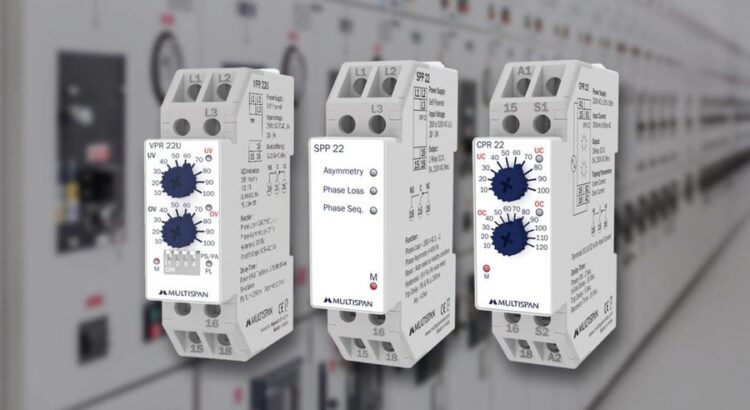
When a fault occurs in an electrical system, the difference between a brief interruption and a major failure can come down to milliseconds. Something has to detect the problem, decide what to do, and act fast. In medium-voltage and industrial power systems, that something is often a protection relay.
A protection relay is a device that continuously monitors electrical conditions and signals a circuit breaker to open when it detects a fault or abnormal situation. It acts as the brain of a protection scheme, protecting equipment, limiting damage, and keeping people safe. Here is how it works and why it matters.
The Basic Job
Every protection relay does three things.
- Measures: It reads current, voltage, and sometimes frequency or other signals through instrument transformers.
- Decides: It compares those readings with programmed settings to determine if something is wrong.
- Acts: If a threshold is crossed, it sends a trip signal to a breaker to isolate the problem.
All of this has to happen quickly and reliably, since the faster a fault is cleared, the less damage it causes.
What Relays Protect
Protection relays guard many types of equipment.
- Feeders and lines: Cables and overhead lines that carry power.
- Transformers: Costly equipment that needs protection from internal faults and overloads.
- Motors and generators: Machines that face unique risks such as overheating or loss of synchronism.
- Busbars: The central connection points in substations and switchgear.
- Capacitor banks: Equipment used for power factor correction.
Common Types of Faults
Relays are designed to respond to different problems.
- Short circuits: A sudden, large current flow between conductors or to ground.
- Overloads: Sustained current above normal levels.
- Ground faults: Current leaking to ground.
- Voltage and frequency issues: Too high, too low, or unstable supply.
- Arc flash events: Dangerous releases of energy inside enclosures.
Electromechanical, Static, and Digital Relays
Protection relays have evolved over decades.
- Electromechanical relays: Older devices that use moving parts, and are still found in many existing installations.
- Static relays: Used electronic components, but with limited flexibility.
- Digital or numerical relays: Modern microprocessor-based devices that offer multiple protection functions, measurement, communication, and event recording in a single unit.
Digital relays have become the standard for new installations because they combine many functions, simplify wiring, and provide data that helps with analysis.
Why Speed and Selectivity Matter
A good protection scheme is fast but also selective. Selectivity means only the part of the system closest to the fault should trip, leaving the rest of the network running. Achieving that takes careful coordination of relay settings throughout the system.
Communication and Integration
Modern relays do more than trip breakers.
- Communicate with control systems: Standard protocols allow relays to share data with supervisory systems.
- Record events: Fault records and waveforms help engineers understand what happened.
- Support remote access: Settings and data can often be reviewed from a safe distance.
- Include cybersecurity features: Protecting connected devices has become an important part of the design.
International standards such as those from IEEE standards and other bodies help ensure that equipment from different makers works together.
Safety Benefits
Fast fault clearing protects people as well as equipment. Features such as arc flash detection can reduce the energy released in an incident and lower the risk to workers near energized equipment.
What to Consider When Selecting a Relay
- Application: Feeder, motor, transformer, generator, or another type of protection.
- Voltage level and system type: Medium voltage needs differ from low voltage.
- Required functions: Overcurrent, differential, distance, or others.
- Communication needs: Protocol support and integration with existing systems.
- Ease of use: Software tools for setting, testing, and maintenance.
- Lifecycle support: Availability of spare parts and long-term service.
Retrofits and Upgrades
Many facilities still run older electromechanical relays. Retrofit relays are designed to replace them with minimal changes to panels and wiring, giving older installations the benefits of modern protection without a full rebuild.
The Quiet Guardian
Protection relays do their best work when nobody notices them. When a fault happens and the system recovers quickly, with limited damage and no injuries, it is usually because a relay did exactly what it was designed to do.